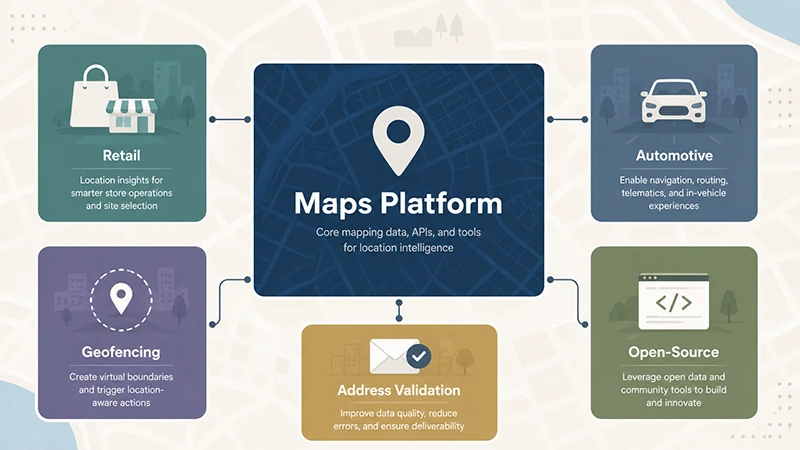
These are the four vendors that compete with Google Maps Platform on the same surface area - maps display, geocoding, routing, autocomplete, places - and that sell into the same buying committee. They are the names that appear when a CTO writes "Google Maps Platform alternatives" on a whiteboard.
Mapbox
Mapbox is the closest dual to Google on developer surface, with 4 million plus developers, Mapbox Studio for visual map design, vector-tile delivery, and a strong navigation stack. Free usage tiers available across all APIs (e.g., 50,000 monthly web map loads), with credit card required at signup.
The Mapbox roadmap is focused on automotive. The company ships an ADAS SDK and a Dash in-vehicle app, and powers the navigation in vehicles including the Toyota RAV4. That focus shapes everything else: feature additions tend to optimise for cars and embedded screens rather than e-commerce or marketplace funnels. Major clients include Meta, Snapchat, and the Financial Times.
Infrastructure is US-hosted (AWS-US), and Mapbox states it does not sell personal data. Some product terms, notably the Navigation SDK and Dash App, grant a perpetual, transferable, sublicensable, worldwide, irrevocable licence on user inputs. These clauses apply to specific products, not all Mapbox APIs, but they require legal review before enterprise adoption. The dedicated breakdown in the Mapbox alternative analysis covers the SDK and licensing trade-offs in depth.
Mapbox competes with Google most directly in markets where map cartography or in-vehicle navigation is the primary requirement. It is not the leader where the requirement is European retail conversion or address quality across the United Kingdom and Ireland.
HERE Technologies
HERE has the deepest fleet and routing depth of any commercial mapping platform. It was spun off from Nokia and is backed by Audi, BMW, and Mercedes-Benz. It is the default choice for truck routing with weight, width, height, hazmat, and toll constraints, electric-vehicle charge-aware routing, and multi-cloud deployments across AWS and Azure. SLA sits at 99.9%, and a Model Context Protocol server connects HERE data to AI workflows.
HERE has a documented pattern of regular price increases, including a 6% rise in April 2026 for new contracts and renewals - one of several increases over multiple years. Multiple editions (Explore, Navigate) and a Style Editor make onboarding more complex than the smaller B2B platforms.
HERE wins against Google when the buyer is a fleet operator, an automotive OEM, or an enterprise that needs commercial-vehicle routing depth. It is less aligned with retail e-commerce or marketplace conversion use cases. The HERE alternatives breakdown compares HERE feature-by-feature against the rest of the category.
TomTom
TomTom is the second European challenger, with a Pay-as-you-grow model, free usage tiers available across all APIs (e.g., 50,000 daily tile requests and 2,500 non-tile requests), and no credit card required at signup. Orbis Maps blends open OpenStreetMap data with TomTom's proprietary base, and the platform is known for industry-leading real-time traffic data.
The Maps SDK for JavaScript ships with TypeScript support, and the Map Editor gives a visual customisation surface. Electric-vehicle routing includes charging-stop optimisation.
TomTom competes with Google primarily on traffic depth and on a friendlier free-tier experience. The lack of a credit-card requirement at signup is a real differentiator for teams trying to evaluate before procurement.
Azure Maps
Microsoft's Azure Maps is built on TomTom and HERE data, with Azure Active Directory authentication, Power BI integration at no extra mapping cost, and Creator for indoor maps. Free usage tiers available across all APIs (e.g., 5,000 base map transactions per month). Autocomplete bills every 10 requests as one transaction. Weather and air quality, including severe weather alerts, ship in the same surface.
The Gen1 pricing model retires in September 2026, with Gen2 as the forward path. Bing Maps is approaching sunset, which creates a migration opportunity for existing Microsoft-stack customers who would prefer to stay inside the Azure ecosystem rather than picking up a new vendor relationship.
Azure Maps competes with Google when the buyer is already standardised on Azure or Microsoft 365 procurement. Outside that footprint, it competes mainly on data residency options and on the convenience of a single cloud relationship.
2. The specialised challengers
The next layer is more interesting. These vendors do not try to match Google's full surface. They go deeper than Google on one thing that one buyer cares about, and they win that one fight.
Woosmap - the EU retail and marketplace challenger
Woosmap is the European location intelligence platform built for commerce. Headquartered in Montpellier with a London office, founded in 2014, and acquired by Datasharp in November 2025, the platform processes 28 billion plus location context calls per year and serves 220 plus enterprise clients across retail, automotive, logistics, travel, hospitality, insurance, and marketplaces. Published references include Holland and Barrett, Kingfisher, Kia, Accor, Decathlon, Leroy Merlin, Carrefour, and TotalEnergies.
The product surface covers what a commerce funnel needs: Localities API for autocomplete and ROOFTOP-level geocoding with worldwide coverage (except China, Korea, and Japan) and premium precision in France and the United Kingdom from official local data providers; Distance API for driving, cycling, walking, transit, and truck routing with isochrones; Map JS API with vector tiles, 3D, and a StoresOverlay; a Store Locator Widget with WordPress plugin; mobile SDKs for Android, iOS, Flutter, and React Native including a Geofencing SDK; and an MCP Server for AI and LLM integration. Free tier: 10,000 requests per month on most APIs, 5,000 on Details.
Pricing is per 1,000 requests in USD or EUR or GBP, not credit-based, with no subscription tiers. Localities Autocomplete is free at all volumes. The Woosmap target ratio versus Google Maps Platform Pro tier sits in the 40 to 50% range for equivalent API usage.
Woosmap competes with Google where the buyer is an EU retailer, marketplace, or logistics operator with GDPR exposure, a measurable conversion funnel, and a board that asks "where is our customer location data processed." It is not a turn-by-turn navigation product and not designed for consumer-facing mobile apps. For the deeper buyer's perspective on where Woosmap fits in the broader competitive set, the migration business case and the TCO comparison are the next reads.
Radar - the geofencing and trip-tracking challenger
Radar is a United States-based platform focused on geofencing and trip tracking. It ships polygon and circular geofences with dwell time, location-based push notifications, and fraud detection that catches location spoofing - the only major Google challenger with spoofing detection as a first-class feature. Clients include Panera, DICK'S Sporting Goods, T-Mobile, and Zillow. Radar's published claim is "up to 90% less expensive" than Google for comparable workloads.
Recently expanded into maps, geocoding, and search, Radar still competes with Google primarily on mobile location triggers, not on the full mapping surface. For teams whose product is a mobile app with location-aware notifications - quick-service restaurants, mobility, retail loyalty - Radar is the natural Google alternative. The Radar alternatives breakdown covers the geofencing-specific trade-offs.
Algolia - the search-led marketplace challenger
Algolia is not a mapping platform. It is the leading text search engine for marketplaces, with typo tolerance, faceting, and ranking signals that no Google product matches at the same SDK ergonomics. Algolia has a geo layer that geocodes addresses, but the layer is basic - no landmarks, no neighbourhoods, no service-radius search.
Algolia competes with Google where the buyer is a marketplace whose product is search ("find me a plumber in Lyon, sorted by rating"). It complements rather than replaces a full location platform: the typical pattern is Algolia for relevance and a Woosmap or Mapbox layer for the spatial primitives Algolia does not have.
3. The honorable mentions
Loqate (GBG)
Loqate, owned by GBG, is the United Kingdom and European leader in address validation and data quality. It is used 70 million plus times per day across 245 plus countries, with on-premise and cloud editions, CASS certification for United States addresses, and 20,000 plus customers worldwide. Loqate validates and corrects addresses after the user has entered them - a different point in the funnel from real-time autocomplete. The platform is structurally complementary to a location intelligence platform, not a replacement. For retailers focused on cleaning up the address file post-checkout and avoiding failed deliveries, Loqate is the specialist.
OpenStreetMap with Leaflet or MapLibre
The open-source layer is real competition for Google in projects where map display is the only requirement and engineering capacity exists to host the rest. Leaflet is a roughly 42 KB JavaScript library under a BSD licence, used by Wikipedia, Flickr, Craigslist, and the Washington Post. MapLibre is the open-source fork of Mapbox GL JS that ships vector tiles and 3D rendering without the commercial licence. Both render OpenStreetMap tiles or any commercial vector provider. The trade-off is real: OSM gives map display only - no geocoding, routing, distance matrix, or store locator out of the box - and data quality varies by region. No SLA, no dedicated support.
Apple MapKit, LocationIQ, MapTiler
Apple MapKit is the default mapping API inside iOS and Mac applications. It does not compete with Google Maps on the web, but for an iOS-first product it can be the right default. LocationIQ and MapTiler both sell hosted OSM with commercial support and pay-as-you-grow pricing, and serve as Google alternatives for teams that want OpenStreetMap data quality with vendor accountability rather than self-hosting.
How the EU Digital Markets Act is reshaping the competitive map
The European Union recognised Google's self-preferencing practices in Article 6.5 of the Digital Markets Act, and the EU has previously fined Google for self-preferencing in search results. Google also operates services - Google Hotels, Google Local Services, Google Flights - that compete directly with many Google Maps Platform customers who happen to be hotels, local service businesses, and travel companies.
For a retailer or marketplace whose location queries pass through Google's infrastructure, the structural fact is that the platform vendor is also a competitor in the buyer's own market. This is increasingly raised by procurement and legal teams as a vendor-selection criterion, separate from price or feature comparison. The DMA does not force any particular outcome, but it has made "is our maps provider also a competitor" a defensible question in vendor reviews.
The category-wide practice of major platforms reserving rights in their terms to use end-user query data for product improvement, model training, or ad targeting applies to several vendors in this space, not only Google. Exact terms vary by product and warrant legal review before any migration. The point is not that one vendor is uniquely problematic - it is that the question has moved from "is it cheap" to "where do my queries go and what is done with them."
How to read the competitive landscape if you are considering migration
The honest summary is this. Google Maps Platform is still the deepest horizontal mapping platform on the market, with the largest POI dataset and the most familiar consumer brand. It loses to specialists in segments where the specialist has gone deeper than the horizontal player on a single dimension.
Buyers who arrive at this question typically fall into one of four situations:
- Cost is the immediate trigger. The starting point is usually a Google Maps API pricing breakdown followed by the TCO comparison. The 40 to 50% per-1,000-request ratio versus Google Maps Platform Pro tier is the structural number for most challengers.
- Data residency or GDPR is the trigger. The buyer needs an EU-hosted location partner with documented data posture. EU-resident vendors simplify the legal surface; US-resident vendors require Standard Contractual Clauses, Transfer Impact Assessments, and ongoing monitoring.
- Vendor lock-in is the trigger. The buyer wants to keep the option to switch. The shortlist favours platforms with portable data, no caching restrictions, and no terms-of-service constraints on downstream use.
- Conversion funnel is the trigger. The buyer is treating location as a conversion lever rather than a map widget. The shortlist favours platforms designed for the Search to Sort to Display flow - autocomplete that does not break, distance and isochrone that match real travel time, and a map fast enough not to drop the user.
In each case, the right competitor for your specific question is rarely the same as the right competitor for someone else's. The market map above is meant to make that difference legible rather than to crown a winner.